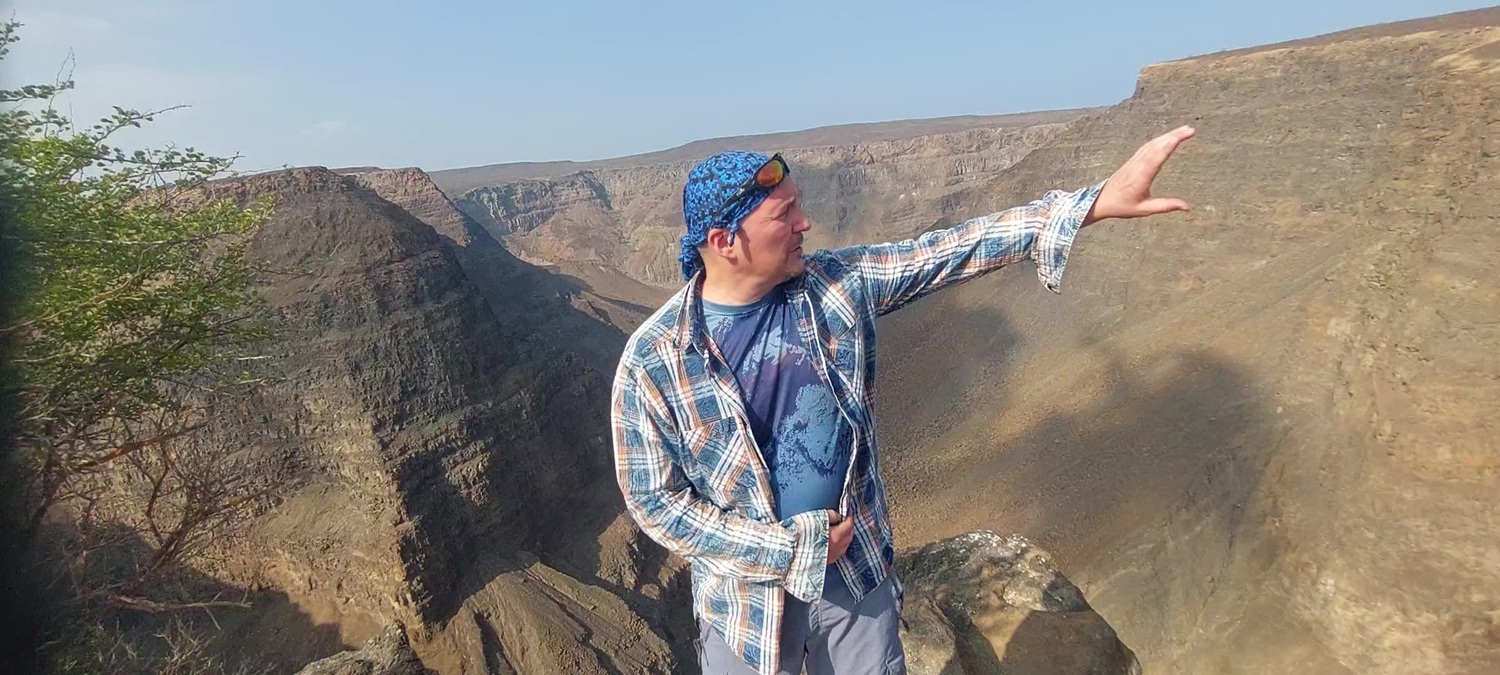
In Rio, the map is not the territory. You can spend weeks walking the streets, but it is only when you lift off that the city’s true, jagged logic reveals itself. My journey with Heli was more than a flight; it was a transition through history, the unique “Carioca” spirit, and the sheer scale of Brazil’s most famous coastline. As a “Frog on the Border,” I seek out these shifts in perspective—from the intimate ground to the expansive sky.
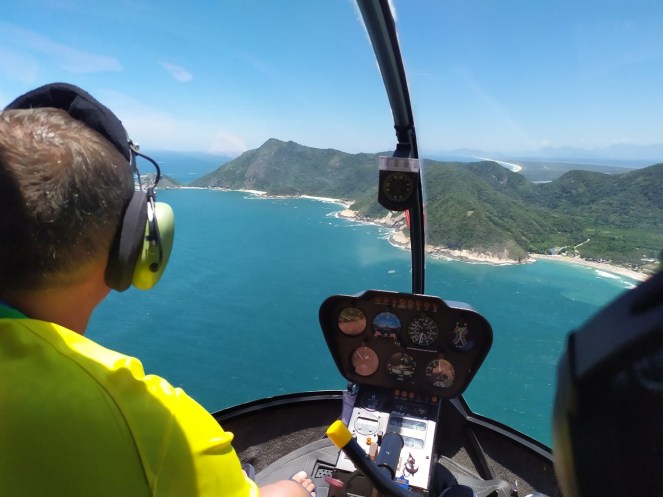
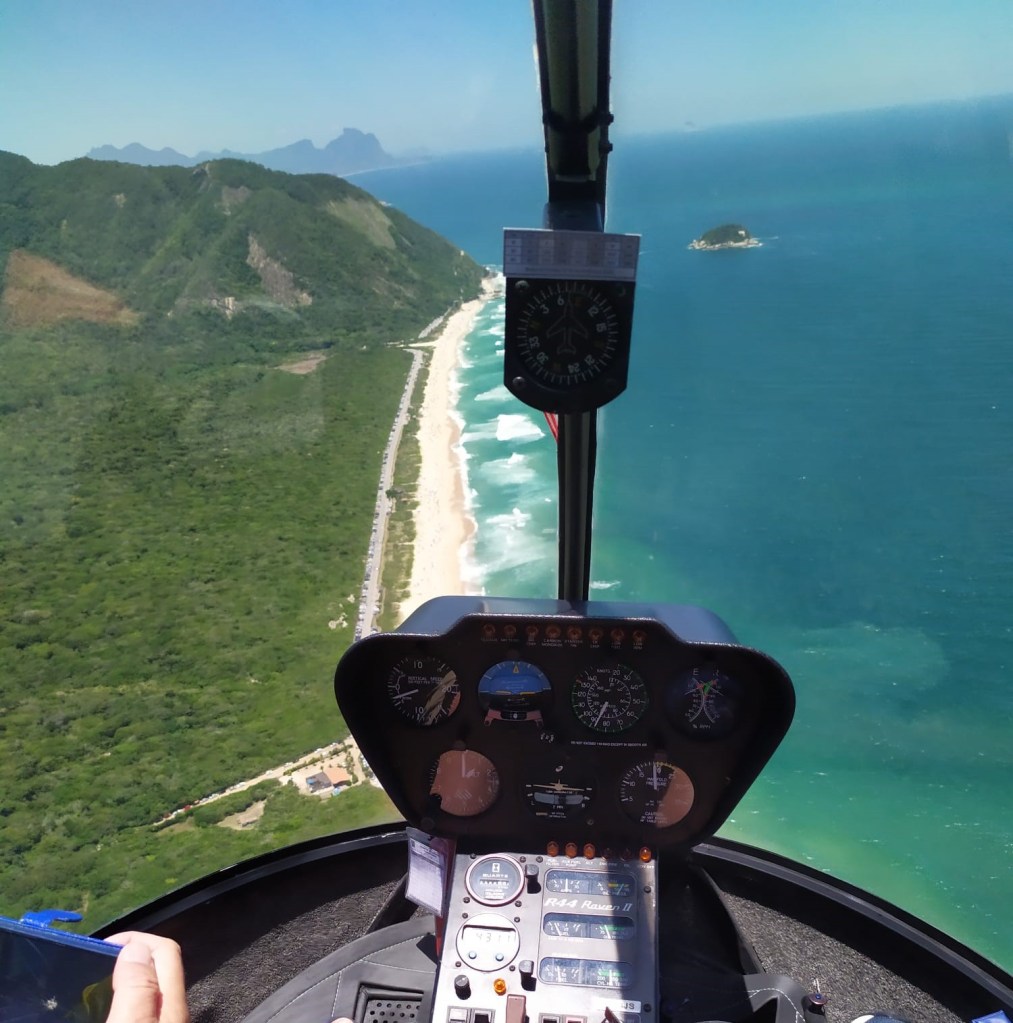
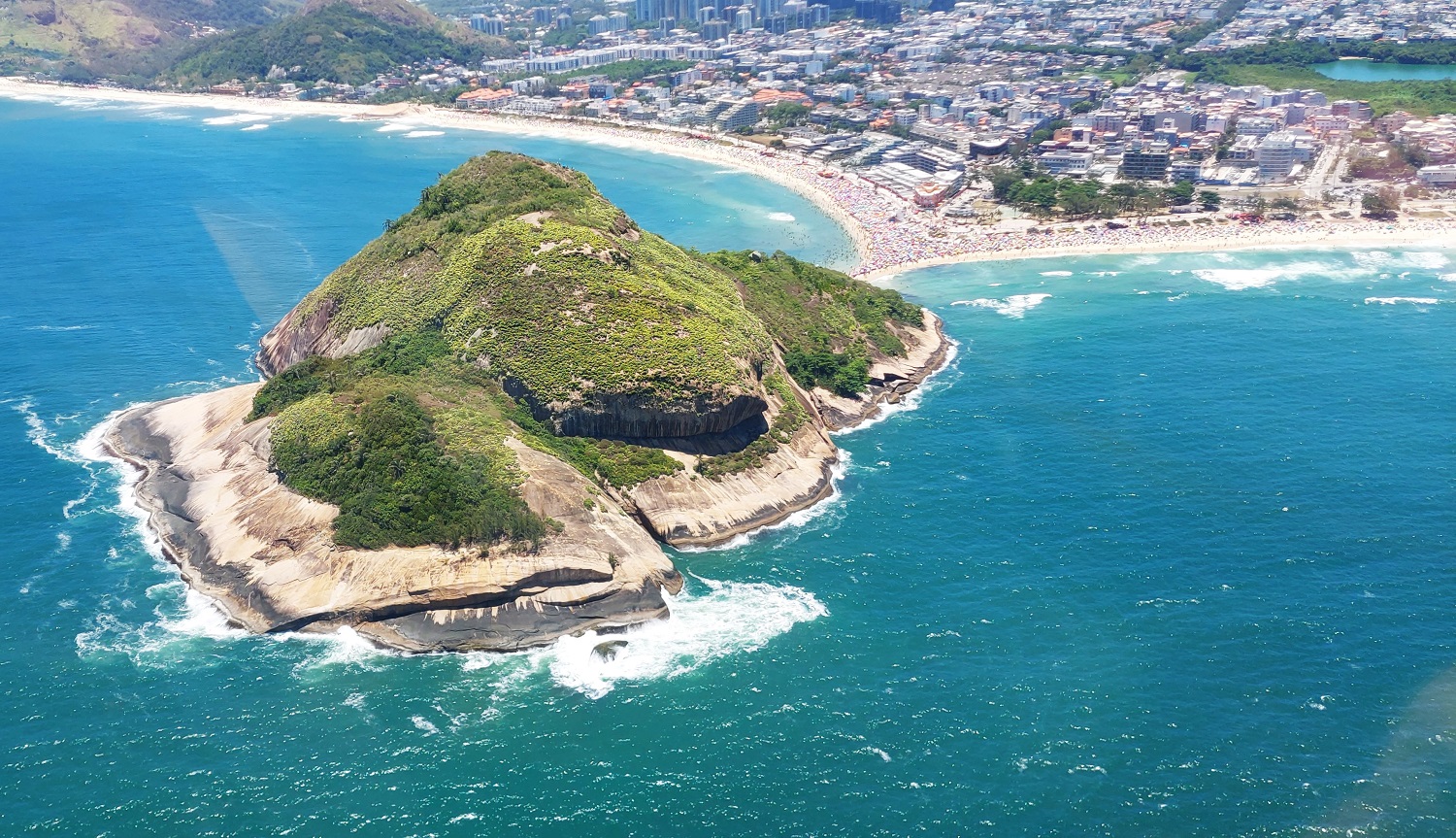
We lifted off from the base in Recreio dos Bandeirantes. On the ground, Recreio feels like Rio’s “Wild West”—it’s newer, more spaced out, and dominated by surfers and local families. From the air, you see the massive Praia da Reserva, a protected stretch of sand where the city’s urban sprawl hasn’t yet touched the Atlantic. As we banked East, we passed over Barra da Tijuca. Stretching for 18 kilometers, it looks like an endless ribbon of white. From the helicopter, you notice the lack of high-rises blocking the sun—a sharp contrast to the dense forests of towers we were about to encounter in the South Zone.
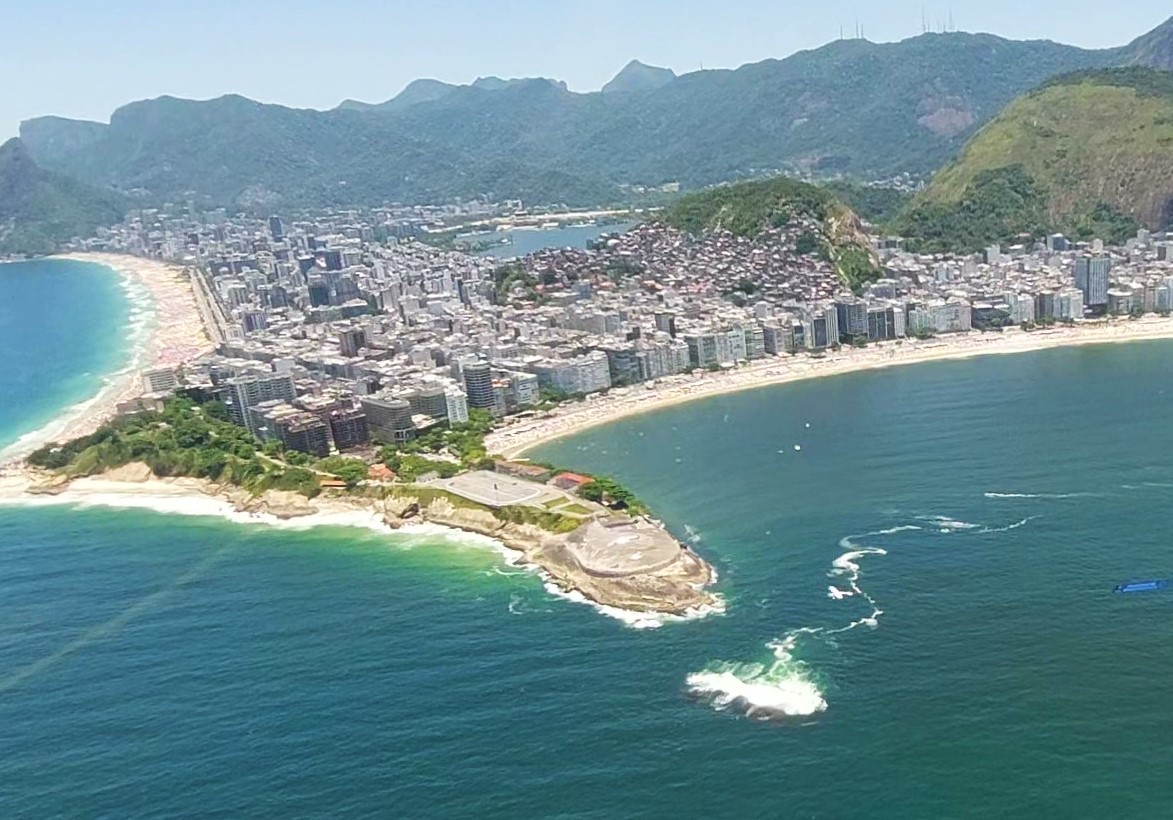
Hovering over the Fortaleza de Copacabana, the sheer scale of the 12-meter-thick concrete walls becomes clear. From above, you can see the Krupp cannons—massive German-made artillery from 1914 that could hit a ship 23 kilometers out at sea. This wasn’t just a building; it was a 40,000-square-meter bunker. In 1922, it was the site of the famous “Revolt of the 18,” where soldiers marched against the government in a suicidal bid for reform. From the air, the fort looks like a grey finger pointing defiantly at the Atlantic, a silent guardian of the entrance to the Guanabara Bay.
As the helicopter banks toward the mountains, the perspective shifts from stone history to living breathing complexity. Looking down into the favelas, the “bird’s-eye” view reveals a world the tourist board doesn’t show. You see the tangled “spaghetti” of illegal electrical wires, the narrow alleys (becos) where no car can pass, and the rooftop water tanks that define the skyline of the poor. But the silence of the helicopter is deceptive. This is a place of constant tension. In recent months, these hills have been the site of intense “Operações Policiais” (police raids). From above, you realize how difficult these operations are; the police use armored vehicles (Caveirões) to try and navigate the steep, narrow climbs while being watched from every rooftop. You aren’t just looking at houses; you’re looking at a strategic battleground where thousands of people are just trying to live their lives, hang their laundry, and raise children amidst the “war of the hills.
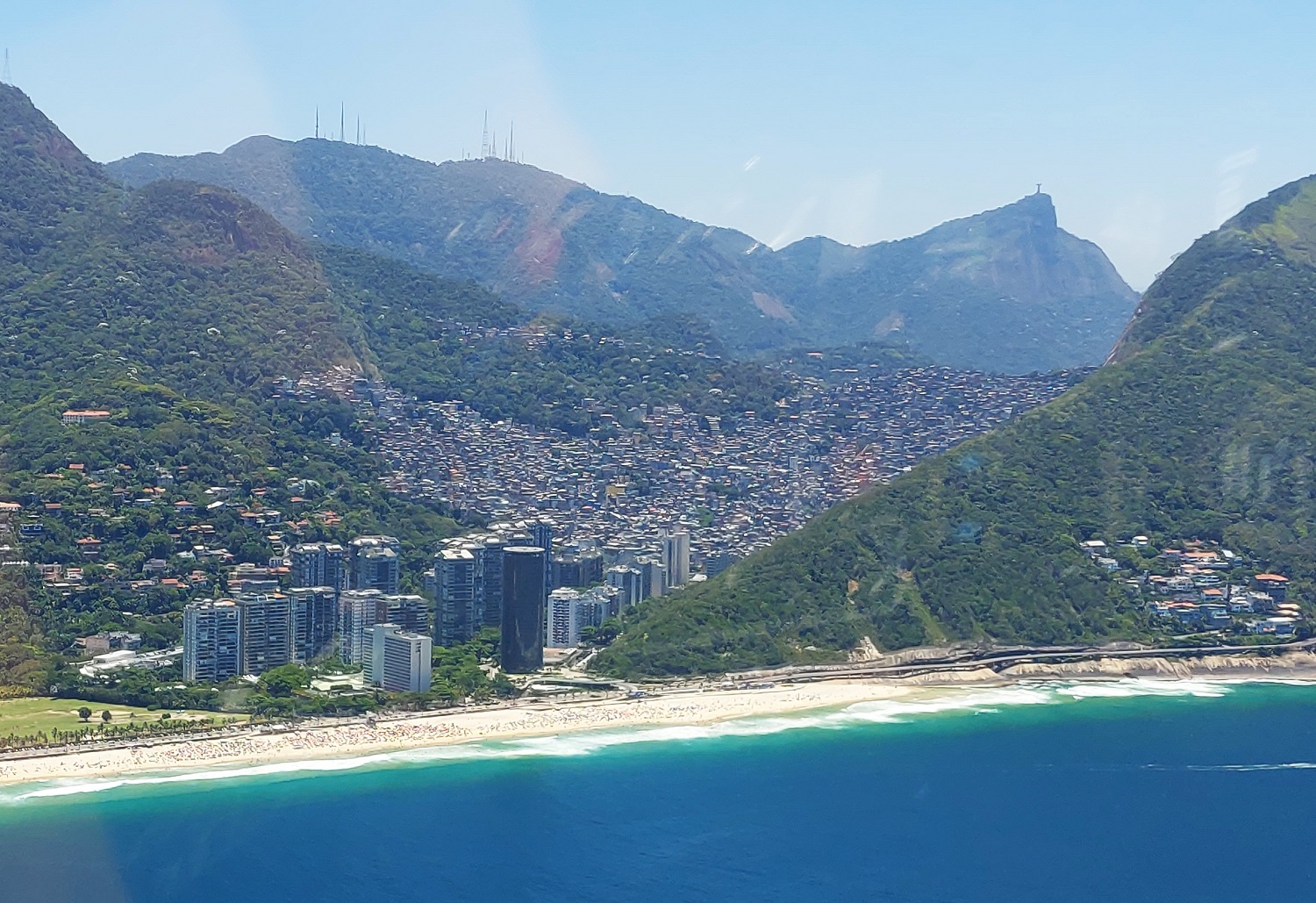
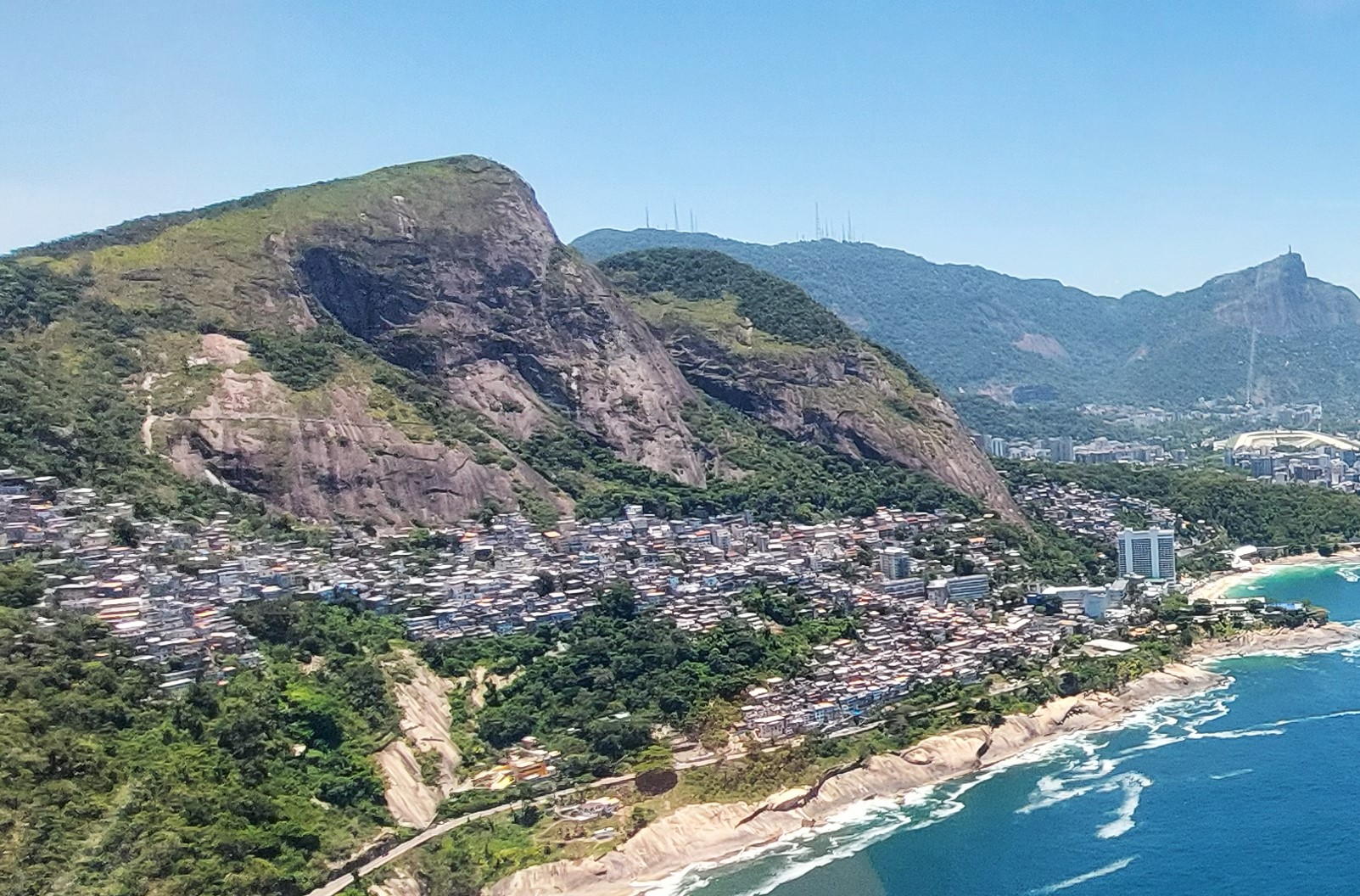
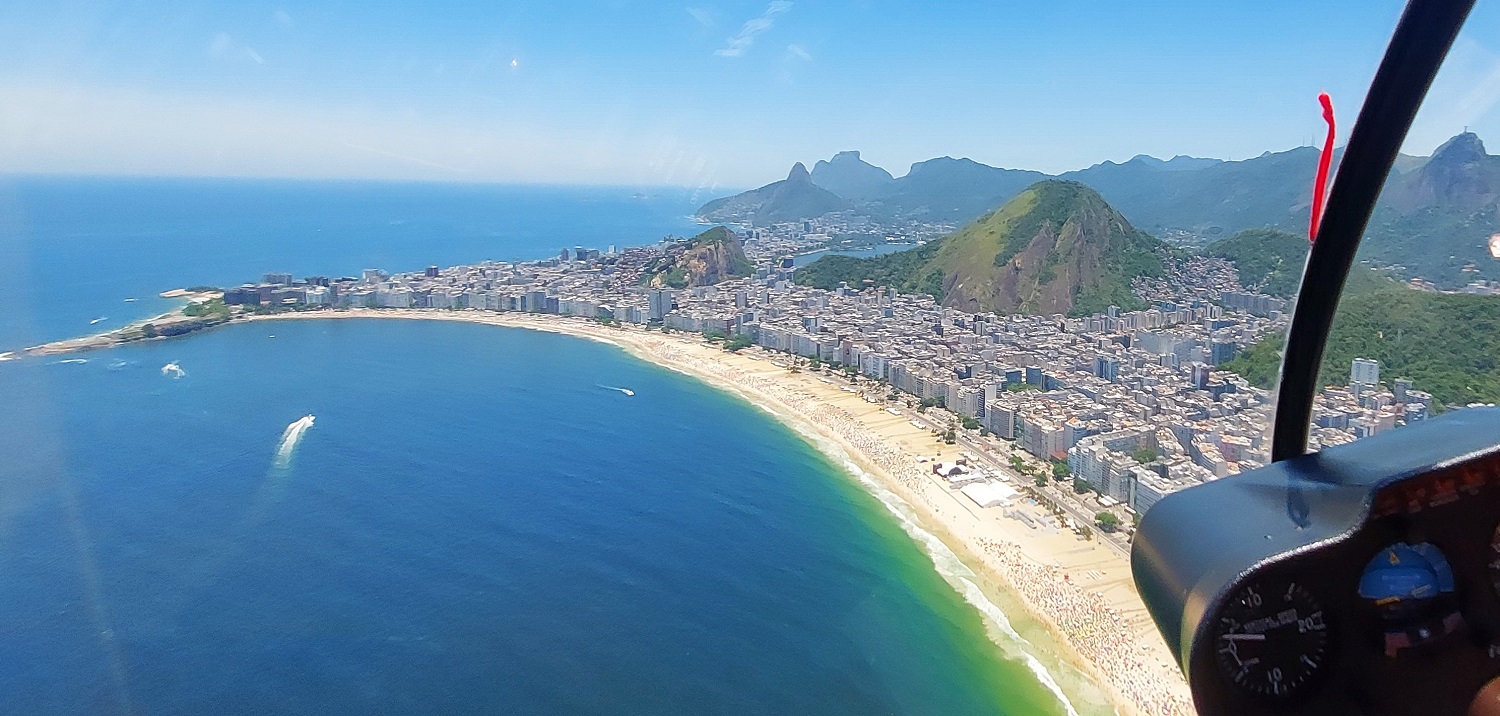
As the helicopter swept over the crescent moon of Copacabana, the scale of its fame became visible. It is 4 kilometers of white sand, but it is also a cultural magnet that draws millions of people into a single, vibrating space.
- The World’s Largest Stage: Seeing the sand from above, it’s easy to see why it’s the “go-to” for mega-events. In 1994, Rod Stewart played a free New Year’s Eve concert here to a staggering 3.5 million people—a Guinness World Record. In 2006, the Rolling Stones rocked 1.5 million fans, and just recently, Madonna (2024) and Lady Gaga (2025) turned the entire beach into a sea of neon and music.
- Why They Flock Here: People don’t just come for the sun; they come for the “Copa” energy. From the air, the mosaic sidewalk designed by Burle Marx looks like a black-and-white wave flowing alongside the ocean. It’s an egalitarian space where millionaires from the Copacabana Palace (where Fred Astaire and Princess Diana once stayed) share the sand with residents from the nearby hills.
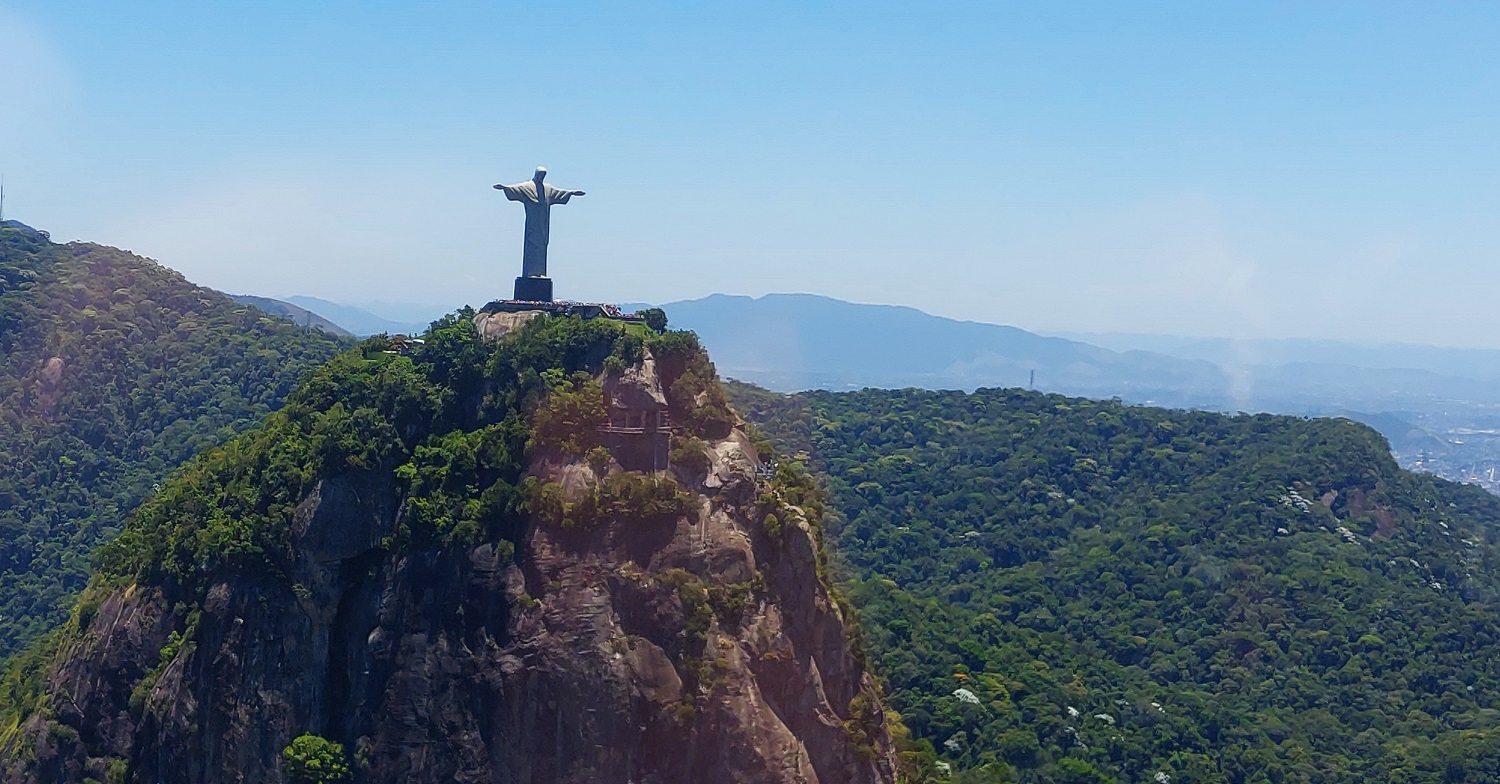
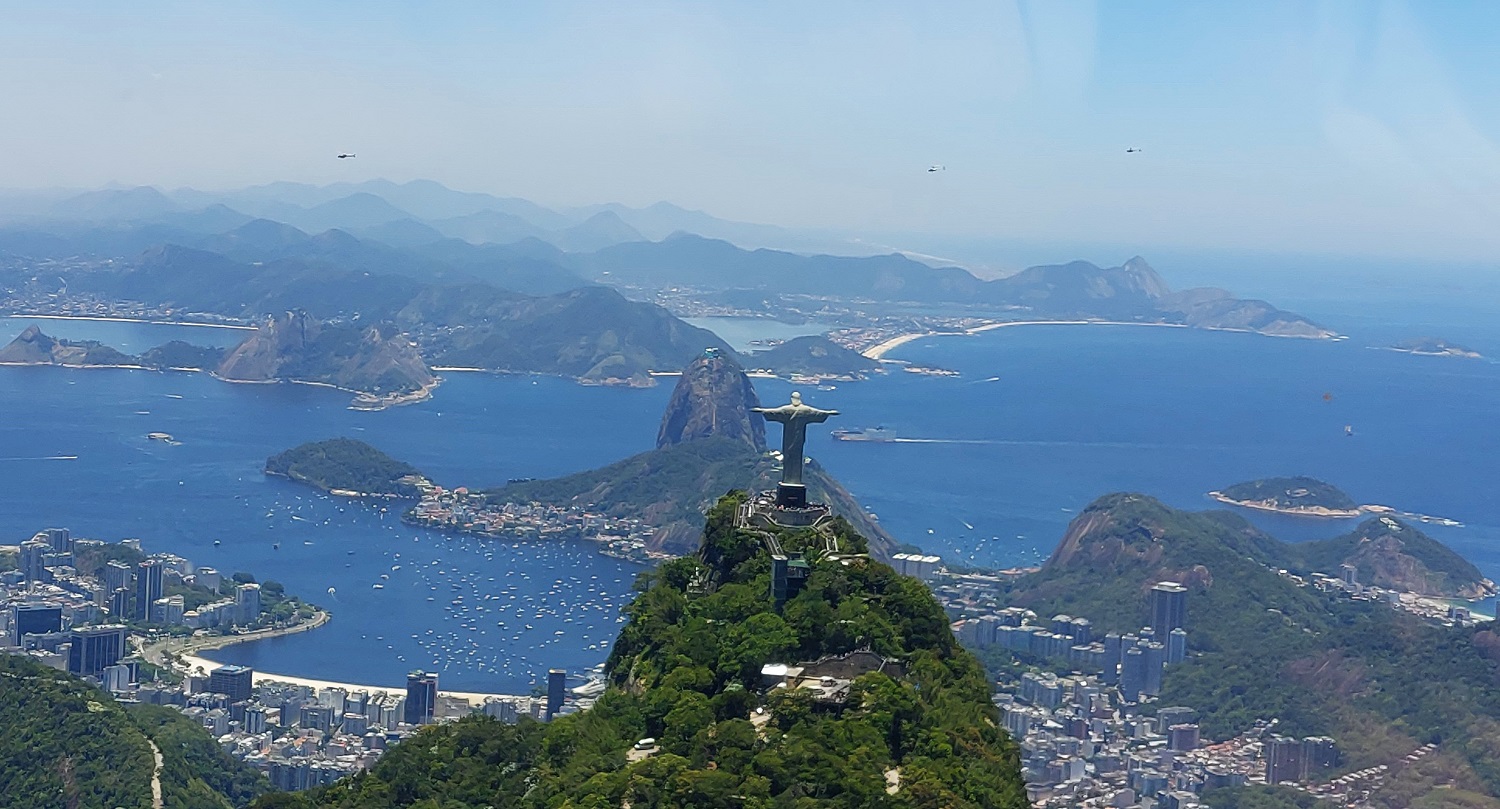
Then, the engine noise seems to fade into the background as we approach Corcovado. This was the moment that felt truly eerie. We didn’t just fly past; we circulated the statue. It is one thing to see the Christ from the streets of Botafogo, but it is entirely another to be at eye-level with those 28-meter-wide outstretched arms. It felt surreal—almost like the helicopter was caught in a gravitational pull. As we banked in a slow, tight circle, I could see the individual soapstone tiles (millions of them) that cover the statue’s skin. For a few seconds, it felt like time stopped. You are suspended between the blue of the Atlantic and the white of the stone, looking directly into the face of an icon that has watched over Rio since 1931. To be that close, hearing the wind and the rotors, feeling the tilt of the helicopter as it “bows” to the statue, you realize why they call this the Cidade Maravilhosa.
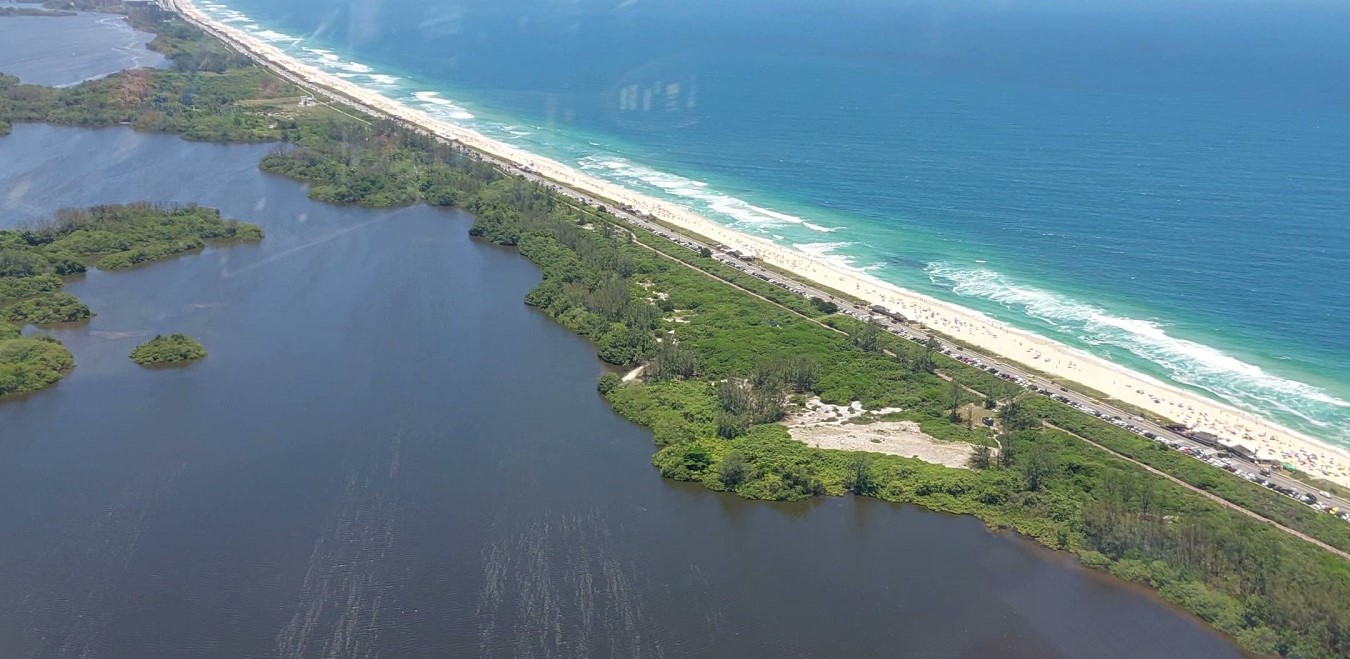
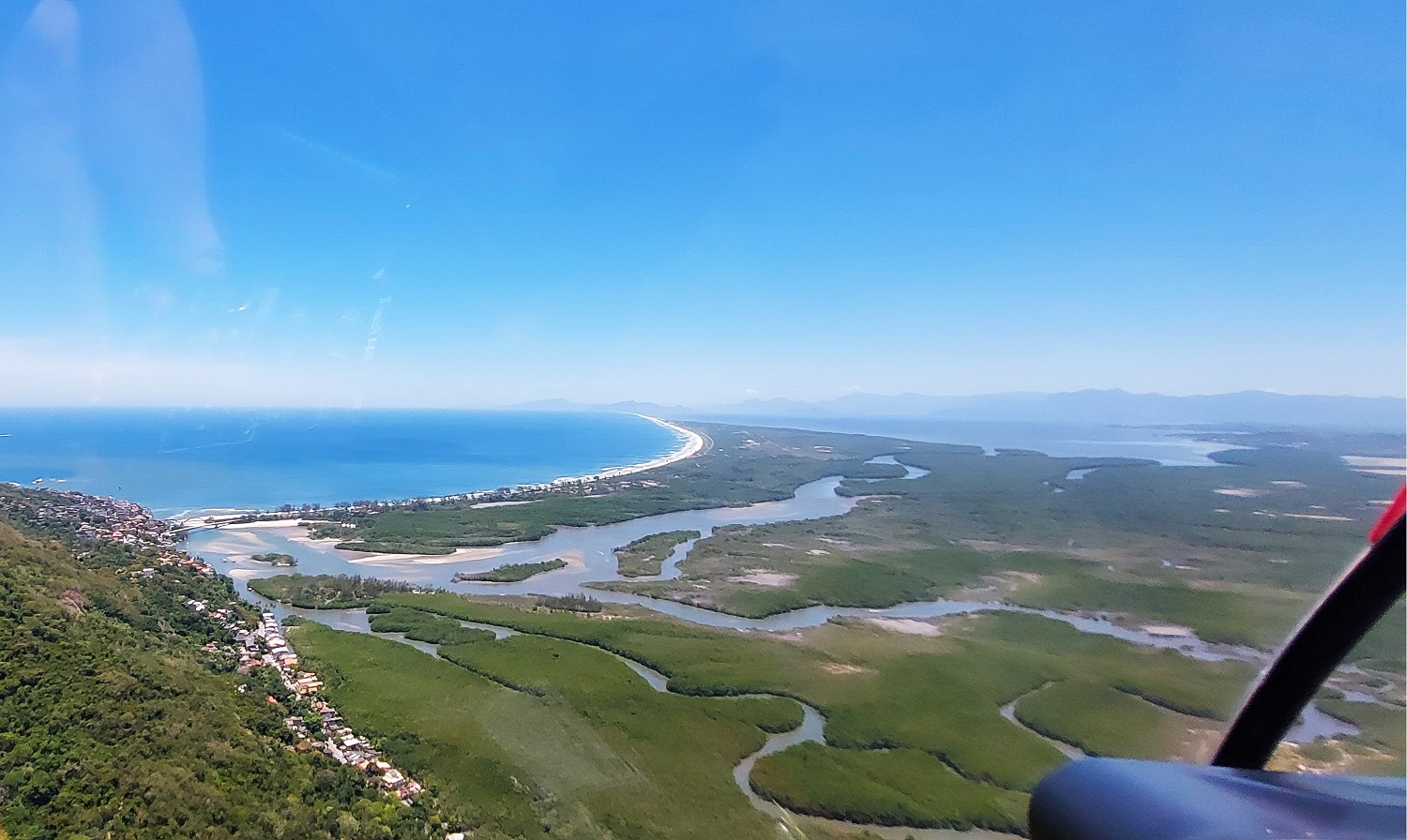
From the air, Restinga de Marambaia looks like a paradise that time forgot—42 kilometers of untouched sand, mangroves, and Atlantic Forest. But as the helicopter banks over the ruins, you realize this isn’t a place for tourists. It is a restricted military zone owned by the Brazilian Navy, and its beauty hides a heavy history.
- The Shadow of Slavery: Long before the military took over, this isolated strip of land served a dark purpose. In the 19th century, after the Atlantic slave trade was officially “banned,” Marambaia became a clandestine landing point. Because it was so isolated, slave ships would secretly dock here to “fatten up” and hide enslaved Africans before smuggling them into Rio’s markets. The ruins you see from above, like the old “Casa do Porto,” are skeletal remains of this era—reminders of a time when this beautiful coast was a gateway for human tragedy.
- A Military Stronghold: Since the 1970s, the Navy has used the area as a high-security testing ground. It houses the Army’s Center for Technology (CETEX), where they develop equipment and train for chemical combat. This military presence is the only reason the land hasn’t been destroyed by urban sprawl; it is one of the best-preserved biomes in Brazil, home to nesting turtles and rare plants, but you can only see it from the sky or with a special military pass.
- The Quilombola Resilience: Despite the military control, a community of Quilombolas (descendants of escaped or freed slaves) still lives on the island. They have fought for decades to keep their land and their history alive in the heart of this high-security zone.
Descending back to the pad, I reflected on my earlier visit to Pier da Barra, that small enclave with its strangely dark, deep water and quiet community feel. It’s the “micro” version of the city’s complex rhythm. But the helicopter had given me the “macro.” Rio isn’t just a city; it’s a living, breathing mountain that grew out of the sea, guarded by a fortress and watched over by a silent, stone giant. For a “Frog on the Border,” it was the ultimate lesson in seeing the world from every possible angle.
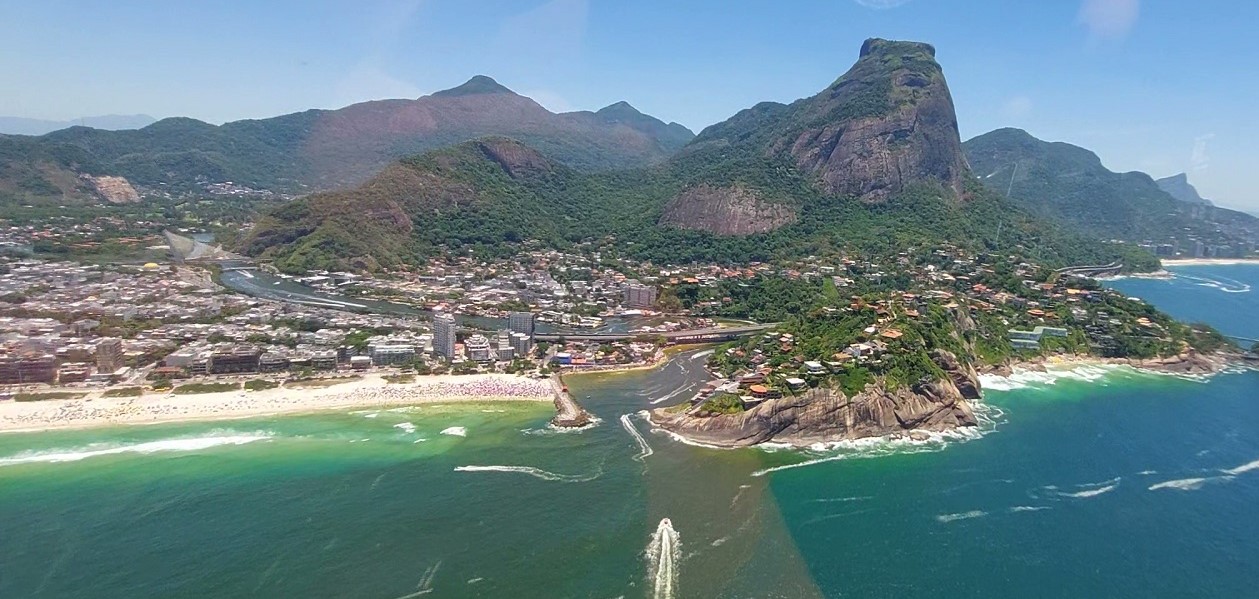
As the rotors slowed and the asphalt of the landing pad rushed up to meet us, I felt a strange weight in my chest. To look at Rio from the sky is to witness a timeline that stretches back centuries. I looked down at the entrance of the Guanabara Bay and tried to imagine the first encounters—the moment the Portuguese explorers first saw these jagged granite peaks in 1502. To them, this was a wild, uncharted frontier, a border between the known world and a staggering new reality. Today, that same coastline is a global magnet; it’s a stage for 3-million-person concerts, a playground for party-goers, and a museum for history buffs tracing the scars of the old fortresses.
Being suspended in that “A Tale of Two Altitudes” wasn’t just about the sightseeing; it was about witnessing the mental and cultural borders of a city. I saw the literal line where the luxury of Leblon stops and the vertical struggle of the favela begins. I saw the dark, quiet waters of Pier da Barra contrasting with the neon roar of Copacabana. Rio is a city that demands you look closer. It challenges you to navigate its history while respecting its present. As a Frog on the Border, I leave the sky knowing that while the scenery is marvelous, the true journey is found in the gaps between—the places where history, safety, and human spirit meet.
 Frog on the border