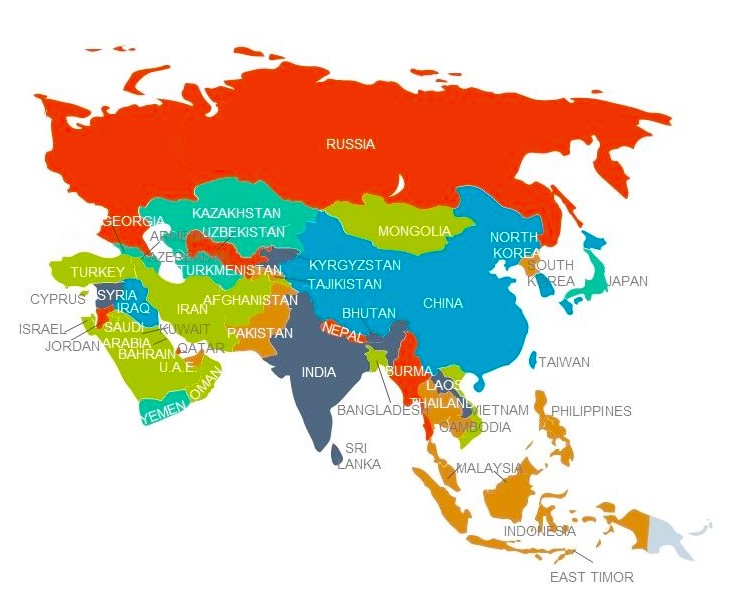
Asia is the largest continent on our planet, both in size and in population. There are 49 countries in Asia according to the UN. Two of the Asian countries also share part of their territory on the European continent; these countries are Russia and Turkey. Additionally, two countries only have limited international recognition: The state of Palestine and the Republic of Taiwan and some dependencies.
More than 4.7 billion people live on the continent. Asia is the most populous continent. India is the most populous country of the Asian continent with more than 1.436 billion people.
The largest country is Russia by area, but roughly 40% of the country is on the European continent. After Russia, China is the largest country by area and China is entirely located on the Asian continent.
The largest city is Tokyo in Japan. With more than 38 million inhabitants Tokyo has the largest metropolitan area and is Japan’s most populous city. This city has more inhabitants than Canada.
The smallest country is the Maldives. This Indian Ocean country is one of the smallest countries in the world and Asia’s smallest country. It consists of 26 coral atolls which in total consist of more than 1,190 islands.
There are 12 landlocked countries in Asia. The landlocked countries in Asia are Armenia, Laos, Nepal, Buthan, and Mongolia. Also, seven central Asian countries ending in -stan: Afghanistan, Uzbekistan, Tajikistan, Turkmenistan, Azerbaijan, Kazakhstan, and Kyrgyzstan. These landlocked Asian countries are located in the interior of the continent and do not have access to any ocean.
The biggest island is Borneo in Southeast Asia is also the third-largest island in the world and the largest in Asia. The island belongs to three countries, Brunei and Malaysia in the north while Indonesia claims the southern part of the island. Borneo is home to vast rainforests and many animals only live on this island such as the Bornean Orang-Utan.
The longest river is The Yangtze River is the longest on the Asian continent and is located in China. It is 6,300 km/ 3,915 miles long. The Yangtze is the third longest river in the world after the Nile and Amazon.
The highest mountain is Mount Everest. It is located in the Himalayan mountain range and the highest peak is 8,849 m/ 29,035 ft high. The Himalayas are between Nepal and China and are the world’s highest mountains.
The biggest lake is the Caspian Sea. The coastline is shared by five countries: Russia, Iran, Kazakhstan, Turkmenistan, and Azerbaijan. The lake is also among the deepest lakes in the world with a maximum depth of more than 1,000 m/ 3,300 ft. Baku, the capital of Azerbaijan, is located at the Caspian Sea.
The driest place is The Gobi Desert, the largest desert in Asia and the fifth largest desert in the world. This is a cold desert where the temperatures can be very low and sometimes even snow can occur.
There are many ethnic groups in Asia. This is a huge continent, where vastly different cultures are practiced. In India and China, the most populous countries in Asia, there are many different ethnic groups all with their own distinct language and culture. Imagine that in India more than 850 different native languages are spoken and used in daily conversations.
India is not only the most populous country in Asia, but it has also the largest number of poor people and child laborers. One in four Indians cannot read or write. Then there are the Koreans, Japanese, Russians, Arabs, Indians, Indonesians, and many other different cultural groups. There are also vast differences in living standards and poverty.
In Southeast Asia, most people live in rural areas outside the big cities which are underdeveloped. In fact, four out of ten poor people who live with only $1.90 per day, live in Asia. However, there is also the tiny country of Singapore which is one of the richest, most modern, and influential cities in the world. Singapore is a city-state and leading country in modern technology and innovation and a major financial centre.
In Asia, more than 2,300 languages are recognized. The most spoken languages are Chinese (all dialects) has more than 1.39 billion speakers while Hindi-Urdu languages (used in India and Pakistan) are spoken by more than 588 million people and there are many different languages in the Hindi-Urdu language group, more than 1,600 languages exist alone in India.
In Indonesia, 600 languages are spoken and in the Philippines over 100 languages. Islam, Hinduism, Buddhism, Taoism, and Confucianism are the main religions in Asia. Many religions originate in Asia, such as Islam which is also the most widely followed religion in Asia. Judaism and Christian faith is practised by smaller population groups in the region.
The biggest cities are in China and have more than one million inhabitants. There are 160 such big cities in China.
Other big cities with over ten million people are:
Pakinstan, Karachi – 24 million people
India, Delhi – 22 million people
Bangladesh, Dhaka – 19 million people
Turkey, Istambul – 14 million people
- Pakistan: Karachi (24 million people)
- India: Delhi (22 million inhabitants)
- Bangladesh: Dhaka (19 million people)
- Turkey: Istanbul, located on two continents Asia and Europe.
Seven of the Asian countries belong to the Commonwealth States. King Charles III of England is the head of the Commonwealth. The Asian nations belonging to the Commonwealth are Brunei, India, Pakistan, Sri Lanka, Bangladesh, Singapore, and Malaysia.
The Asian continent has a very diverse climate ranging from arctic climate in Siberia (Russia) to tropical climates in South-East Asia. Siberia is also one of the coldest places on earth. In the tropical regions of South-East Asia, also the most tropical storms occur. Cyclones occur mainly in the Philippines and south of Japan. Some countries in Asia are at high risk for negative impacts of climate change. In 2004, a tsunami hit the coast in India, Thailand, Indonesia, and other countries and killed more than 250,000 people in more than 14 countries.
 Frog on the border