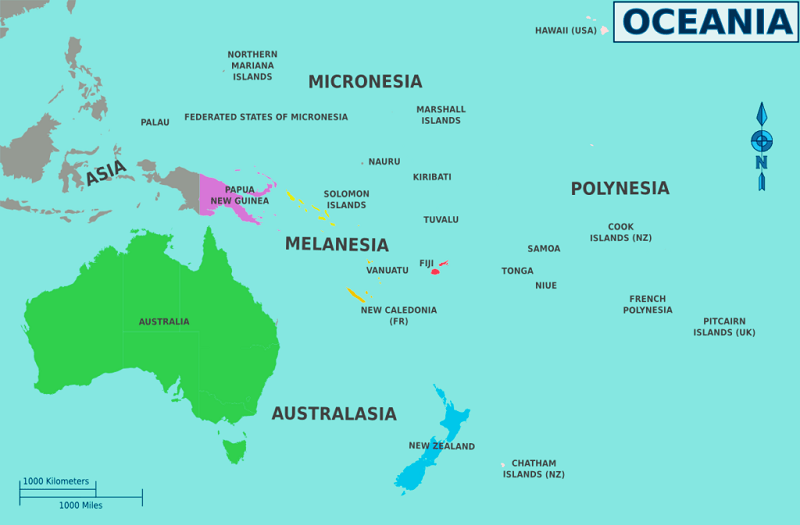
Oceania is the smallest continent considering the landmass. Oceania is in a continental group consisting of 14 countries and includes Pacific islands and Australia. Often Australia is named as the continent, but this means that the many islands and countries except Australia would then be not included.
Oceania includes 14 countries such as Australia, Fiji, Kiribati, Micronesia, Nauru, Marchall Island, New Zealand, Papua New Guinea, Palau, Salomon Islands, Samoa, Vanuatu, Tuvalu and Tonga. Oceania spreads over a vast area from 28 degrees North in the northern hemisphere to 55 degrees South in the southern hemisphere.
The biggest city is Sydney. More than 5 million people live in Australia’s biggest city. Sydney has the most diverse and multicultural population in Oceania. More than 250 languages are spoken here. There are six cities in Oceania with a population of more than one million inhabitants:
- Sydney, Australia – 5.3 million inhabitants
- Melbourne, Australia – 4 million inhabitants
- Brisbane, Australia – 2 million inhabitants
- Perth, Australia – 2 million inhabitants
- Auckland, New Zealand – 1.6 million inhabitants
- Adelaide, Australia – 1.3 million inhabitants
The highest mountain is Mount Cook in New Zealand. The mountain which is referred to also as Aoraki is 3,754 m or12,316 ft high. New Zealand’s South Island has 23 peaks higher than 3,000 m or 9,800 ft. Tasman Glacier is the largest glacier in New Zealand, it is 27 km or16 miles long.
The most diverse landscape is found in Australia and New Zealand due to their size and the varied climatic regions in these countries. In Australia, you have rainforests and deserts as well as dry forests whereas in New Zealand you have alpine regions with only sparse vegetation, such as the Southern Alps with the glaciers. The Pacific Ocean islands have tropical vegetation with tropical rainforests and palm trees.
Oceania is home to many animal species. In Australia, the largest country of the continent, The are marsupials, mammals that carry their young in their pouch. Among them are wombats, koalas, possums, and kangaroos.
Many Pacific Ocean islands such as the Marshall Islands and Palau, Tuvalu, and the Marquesas islands in French Polynesia were further explored by European explorers and people from many regions around the world settled later on these islands.
Dutch explorer Abel Tasman first arrived in New Zealand in 1642 that were already inhabited by the Maōri people. Tasmania was named after him. Spanish explorer Alonso de Salazar reached the Marshall Islands in 1529, these islands were inhabited by the Micronesians already for about 3,000 years. British explorer James Cook was the first to reach Australia in 1770. Seafarers from Europe were exploring the region in the 16th century, however, the Polynesians were the first explorers and settlers.
The island of Palau was settled by Melanesians and Polynesians among others more than 2,000 years ago before European explorers reached the shores of the island. The island was then already inhabited for over 60,000 years by indigenous people, the Aboriginal Australians and Torres Strait Islander peoples.
Most people, 73%, in Oceania describe themselves as Christians. Other religions practised are Hinduism, Baha’i, Jainism, Judaism, Islam, and Buddhism Traditional tribes often also believe in spirits and natural forces.
Australian Indigenous rock art has the longest art tradition in the world. Aboriginal paintings in Arnhem Land date back more than 60,000 years and this art form is still practised by indigenous people in Australia. As writing forms were not explored, their artistic expression was mainly consisting of paintings and carvings.
 Frog on the border