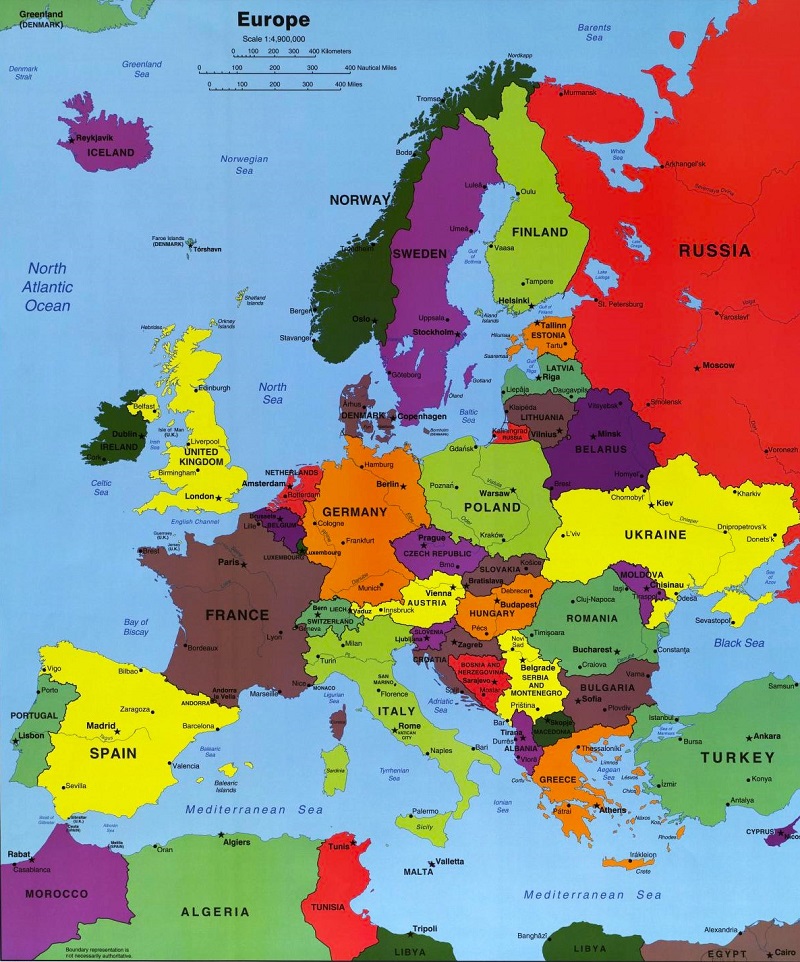
Europe is the second smallest continent in size but the third largest in population. The European continent houses a land area of fifty countries. However, of these fifty countries, only forty-four have their capital city on the European continent. Of the European countries, twenty-seven nations belong to the European Union. The European continent is located completely in the northern hemisphere and mainly in the eastern hemisphere. Europe borders the Arctic Ocean in the North, the Atlantic Ocean in the West, and the Mediterranean Sea in the South. There are 50 countries in Europe with a total of more than 745 million people living on the continent.
The largest country is the European part of Russia covers more area than any other country. The three largest countries completely located in Europe are France and Ukraine.
The smallest country is Vatican City. It is the smallest country not only in Europe but also in the world. The city-state, an enclave within Italy, is the smallest country both by population and by size. The largest landlocked country is Kazakhstan is the largest landlocked country in Europe and in the world. 18 million people live in Kazakhstan which is among the ten biggest countries in the world. However, only about one-fifth of the country’s land area is located on the European continent.
The largest landlocked country located entirely on the European continent is the Czech Republic. Landlocked countries in Europe: Many countries in Europe, mainly in central Europe, do not have access to an Ocean and share national borders only with other countries. These are Austria, Armenia, Andorra, Belarus, the Czech Republic, Kazakhstan, Switzerland, Hungary, Kosovo, Bosnia-Herzegovina, Luxemburg, Slovakia, Serbia, Liechtenstein, Moldova, San Marino, Vatican City and Macedonia.
San Marino and Vatican City are landlocked inside Italy, and Liechtenstein is double landlocked as it is landlocked by countries Switzerland and Austria which are also landlocked by other countries.
The largest city is Moscow. The Russian capital city is home to more than 13 million inhabitants within the city limits. Saint Petersburg is Russia’s second largest city with 5.3 million inhabitants. Moscow is the largest city that is entirely on the European continent.
The most populous city is Istanbul, the biggest city in Turkey and is commonly referred to as Europe’s largest city. However, Istanbul is located on two continents: the western part belongs to Europe while the eastern part belongs to the Asian continent. Istanbul houses about 17 million people. The most densely populated country is Monaco. The principality bordering the Mediterranean is the most densely populated country in the world.
The smallest city is Hum in Croatia. It is the smallest town not only in Europe but in the world. The town has only 30 inhabitants.
The northernmost town in Europe is Ny-Ålesund on Svalbard in Norway. Only about 35 people live there all year round, but in summer, about 120 people are staying in the town. The town is used as a base for explorations and research. The northernmost capital city is Reykjavík in Iceland is Europe’s and the world’s most northern capital city.
The biggest island on the European continent is the United Kingdom. Greenland is the largest island which belongs to Europe as the island belongs to Denmark. Greenland is commonly referred to as the largest island in the world. Greenland, however, is located on the North American continent.
The highest mountain in Europe is Mount Elbrus in Russia (5,642 m/ 18,510 ft). The mountain is part of the Caucasus mountain range. The highest peak in the European Alps is Mont Blanc. The mountain which is 4,810 m/ 15,781 ft high sits on the border of France and Italy. The Alps are also the longest and highest mountain range, located entirely in Europe.
The longest river is the Volga River in Russia is Europe’s longest river. It is 3,692 km/ 2,295 miles long. The most important commercial waterway is the Danube. The river that flows through ten countries is the second longest river in Europe with 2,860 km/ 1,777 miles. The port of Rotterdam in the Netherlands is the largest and busiest container port in Europe. The longest coastline in Europe has Norway with over 100,000 km/ 62,000 miles, and it is the second longest in the world.
The biggest lake is Lake Ladoga near Saint Petersburg in Russia is Europe’s biggest lake and one of the world’s largest freshwater lakes. The lake is slightly smaller than Lake Ontario, which borders the USA and Canada. The largest waterfall is The Rhine Falls in Switzerland is the largest plain waterfall in Europe. They are 150 m/ 492 ft wide and 23 m/ 75 ft high.
About 10% of the world’s population lives in Europe. In Russia, about 78% of the population, that is more than 110 million people live in the European part of the the world’s largest country. Most of the European population groups, almost 90%, belong to one of the three Indo-European language groups of the Slavic, Romance, and Germanic language groups.
Most European languages belong to either the Romance languages such as Spanish, French, and Italian, the Germanic languages, among them are English and German, English or the Slavic languages, among them Polish, Bulgarian and Russian. Russian is the language with most native speakers (about 100 million), while English as the ‘lingua franca’ is the language spoken by most people as first and second language (about 270 million people). The five most spoken native languages in Europe are German, Russian, English, French, Italian and Turkish.
Most of the European people are Christians (76%) and there are smaller numbers of Muslims (6%) and Jews and other beliefs. About 18% of all Europeans consider themselves as atheist or not religious.
The first humans appeared on the continent about 35,000 BC. The Minoan civilization in the Bronze Age is seen as the first culture to establish trade and ‘technology’ from 2700 BC. Among the many ethnic groups of the continent, the Germanic, the Italic people, and the Greek tribes had vast influences on the whole region as had the Celts. Later during the Middle Ages, the population increased due to Mongols, Magyars, Tatars, the Vikings, Huns, and many other peoples that arrived and settled in the area.
 Frog on the border