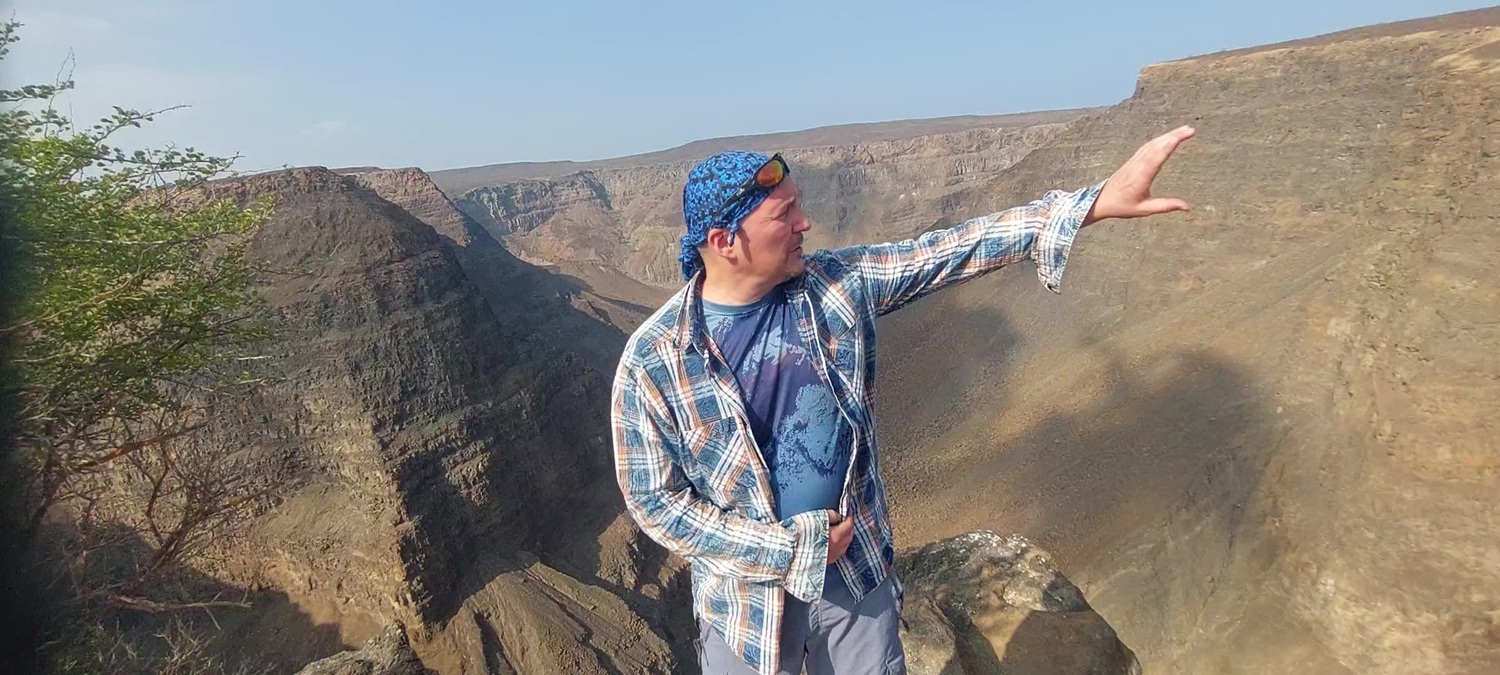
If you’ve been following my journey through Ethiopia here at Frog on the Border—from the surreal, neon landscapes of Dallol to the brutal, sun-baked salt mines of the Afar depression—you know this country is defined by raw, tectonic shifts. But back in November 2022, after leaving the wilderness behind and walking into a quiet, blue-walled room inside the National Museum of Ethiopia in Addis Ababa, I crossed a boundary that made all physical borders look entirely trivial: the 3-million-year line separating modern humans from our evolutionary dawn.
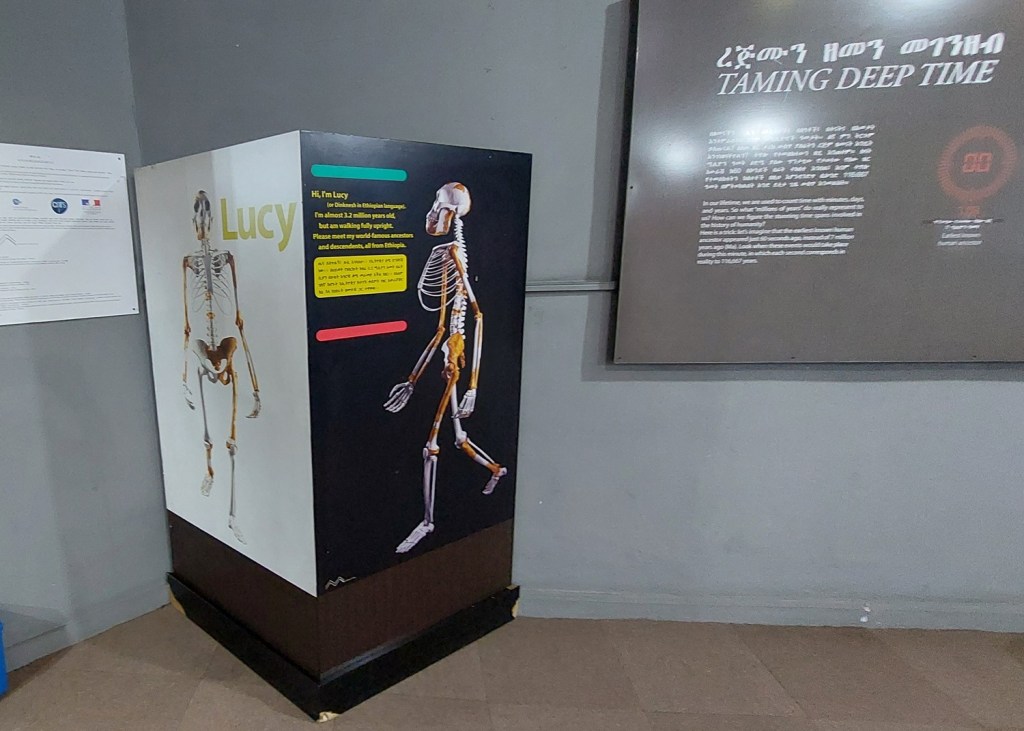
Out here on the border, reality is always grounded, silent, and profound. The evidence of our shared beginnings isn’t a hidden secret; it’s sitting openly under soft gallery lights in Addis Ababa, waiting for anyone to just walk in and look.
The Day the Desert Yielded a Mirror
To understand what it means to stand in that room, you have to travel back to the very place where my Ethiopian journey began: the Afar Triangle. On November 24, 1974, in the harsh, dry gullies of Hadar, paleoanthropologist Donald Johanson and graduate student Tom Gray were surveying the dusty terrain, preparing to wrap up a long day of searching.
As they walked back toward their Land Rover, Johanson caught a glimpse of something small reflecting the harsh midday light on a slope. It was a tiny fragment of an arm bone. Then a piece of a skull. Then a thigh bone, a couple of ribs, and a pelvis.
They hadn’t just found a fossil; they had stumbled into a geological miracle.
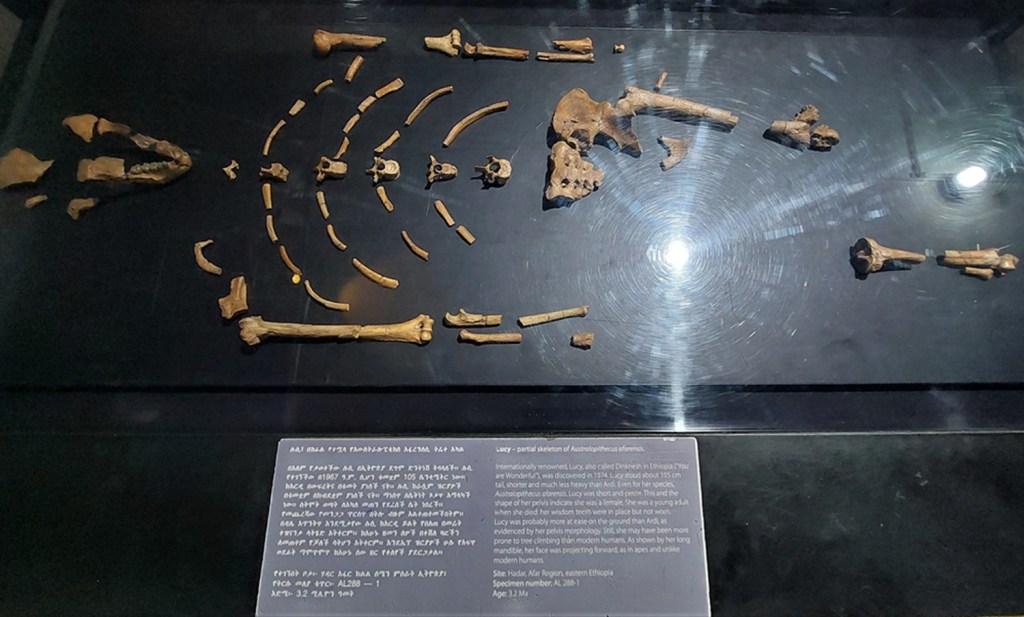
In the world of paleoanthropology, finding a single ancient tooth is considered a massive win. Finding a skeleton from over 3 million years ago that is 40% complete is like winning a universal lottery. Her bones were nicknamed “Lucy” because the Beatles’ song “Lucy in the Sky with Diamonds” was blasting on a loop back at the researchers’ camp that night. But to locals and the official museum placards, she is known as Dinknesh—an Amharic phrase meaning, beautifully, “You are wonderful.”
The Chaos of Preservation: Why Lucy is a Miracle
The sheer fortune required for Lucy to survive 3.2 million years so that we can look at her today is staggering.
When an animal dies on the savanna, nature usually erases the evidence instantly. Scavengers tear the limbs apart, weather rots the bones, and time crushes them into dust. For Lucy to remain intact, a precise domino effect of luck had to occur:
- She had to die in or right next to a dynamic water system—likely a lake margin or a slow-moving river channel.
- Before predators could scatter her remains, a sudden influx of soft river silt and volcanic ash had to gently blanket her body, sealing her away from oxygen and decay.
- The earth above her had to shift, trap, and mineralize her over millions of years, slowly turning her organic bone structure into solid stone.
- Finally, millions of years later, the brutal rain and wind of the Afar desert had to erode away just enough topsoil to expose her bones to the surface—right at the exact historical window before another rainstorm could wash them down the river forever, and right as two humans walked past.
Standing Inches from the Shared Blueprint
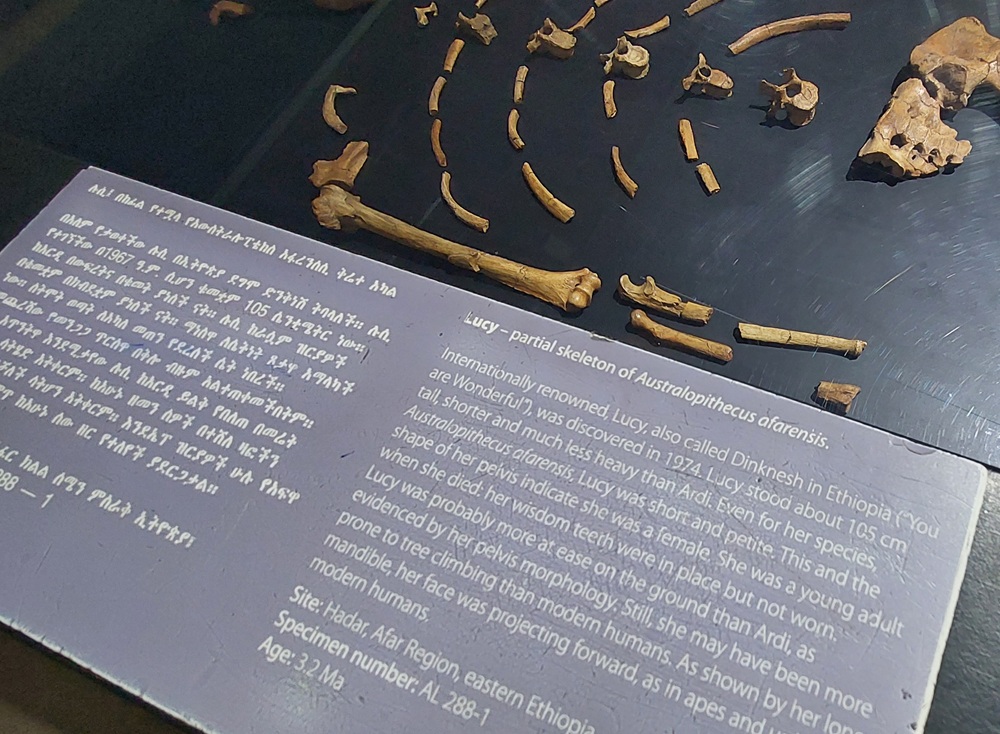
Walking into that museum room in Addis Ababa brings an immediate, overwhelming sense of scale. I stood directly over the glass case, looking down at those ancient, dark brown fragments. Because the display allows you to get incredibly close, the abstraction of “human evolution” instantly vanishes.
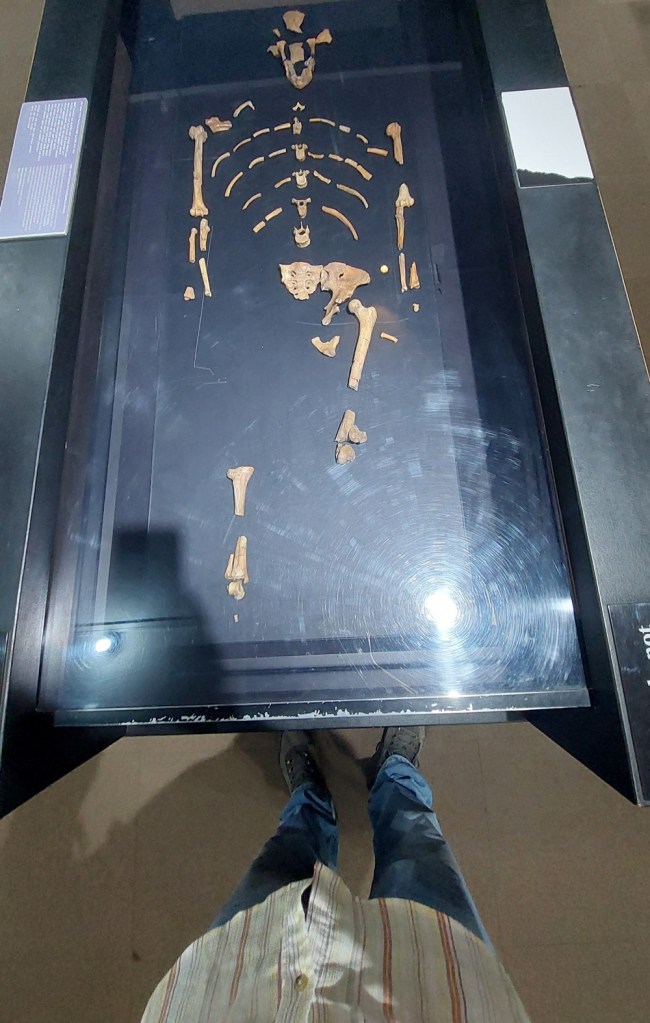
You are looking at a creature who stood just over three and a half feet tall. Her wisdom teeth were erupted and worn, showing she was a fully grown adult when she died. But the real spine-tingling moment comes when you study her anatomy up close:
- Her long arms and curved finger bones show she was still completely at home navigating the branches of trees.
- But her pelvis and the angle of her knee joint are undeniably human. She didn’t waddle like a chimp; she stood up, balanced her weight, and walked flat on the earth.
There is a profound, almost meditative intimacy to feeling that close to an ancestor. Looking at the curve of her jawbone or the small symmetry of her ribs forces a bizarre realization: This isn’t the history of an empire, a country, or a specific race. This is the shared matrix for everyone alive today. Every border we fight over, every passport we hold, and every cultural divide we construct exists on a layer of dirt thin enough to be scraped away. Beneath it, we all share the exact same evolutionary starting line.
Meeting Selam: The Child of Time
Just a few feet away from Lucy sits another breathtaking testament to this landscape: Selam (“Lucy’s Baby”). Though discovered decades later in 2000 in the Dikika region of the Afar, she actually walked the earth roughly 150,000 years before Lucy.
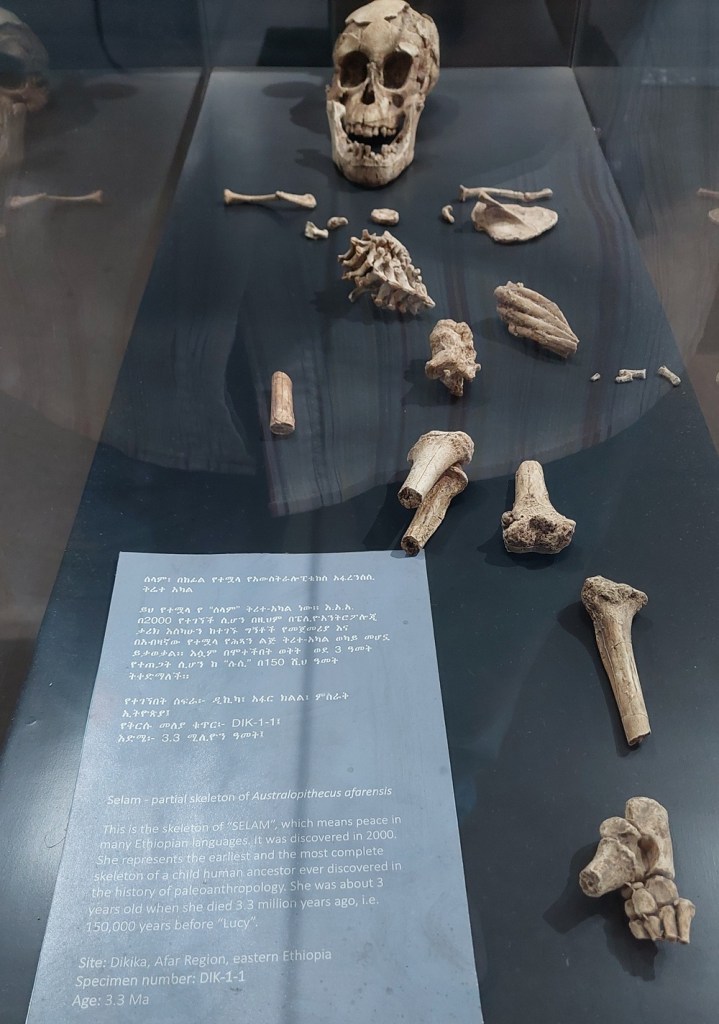
Selam was a three-year-old child. Because she was rapidly buried by river sand immediately after her death 3.3 million years ago, her tiny skull, collarbones, and ribs are even more flawlessly intact than Lucy’s. Standing before a toddler from over three million years ago hits an emotional chord that no textbook can replicate. It grounds the grand, sweeping narrative of science into a quiet, recognizable moment of a life lived and frozen in deep time.
Crossing the Ultimate Border
The open reality of the museum stands as a beautiful testament to modern science. Surrounded by text translated into both Amharic and English, the physical, carbon-dated evidence is there for any traveler to study. Anyone with a passport and a sense of curiosity can walk through those doors, stand inches from the glass, and look straight into their own prehistoric reflection.
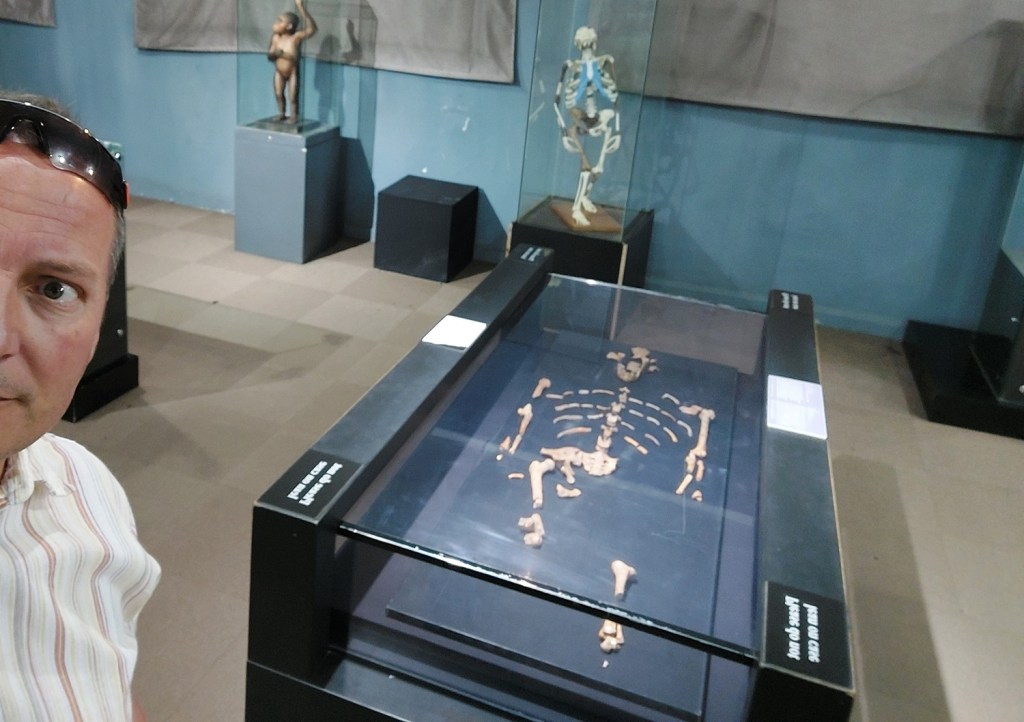
Africa didn’t become the cradle of humanity by political decree. It happened because millions of years ago, the tectonic forces of the Great Rift Valley literally tore the continent’s geography apart—fracturing the ancient rainforests, forcing the trees to retreat, and presenting our ancestors with a brutal choice: stand up and adapt to the open savannas, or disappear.
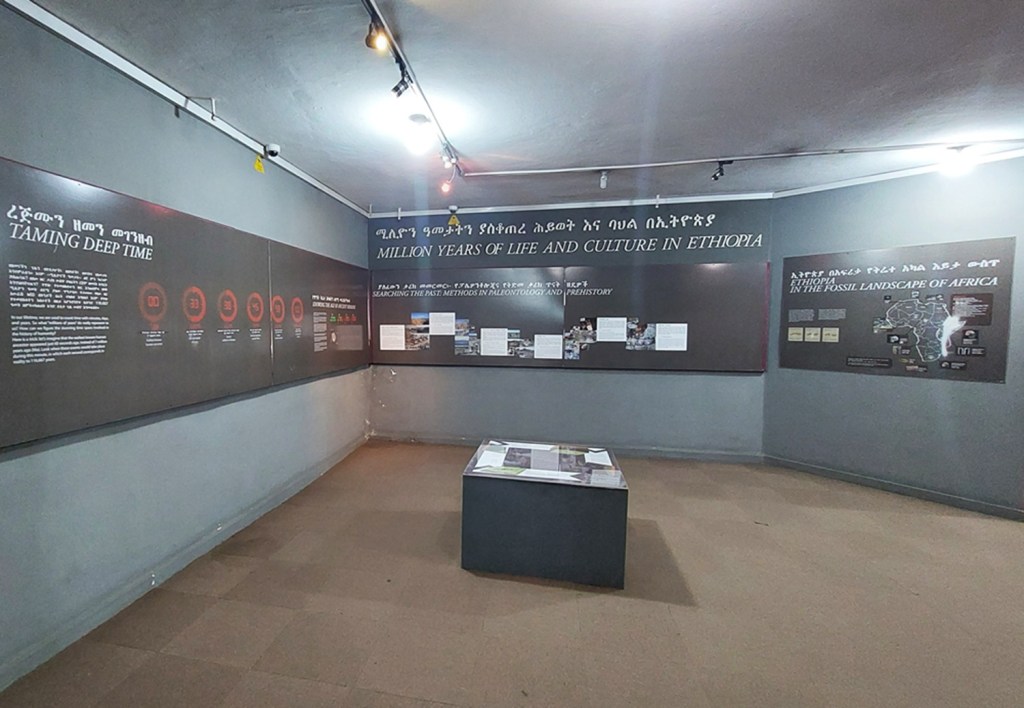
Visiting Addis Ababa reminds us that we are all, ultimately, the descendants of those brave, ancient travelers who stood up, looked across the horizon, and began to walk. And sometimes, to truly understand the modern borders we cross today, you have to travel back to the very first border our ancestors ever crossed: the boundary between being an ape in the trees, and becoming human on the ground.
 Frog on the border