I went to Medina expecting to find an edge, and I did find one. What I did not expect was that it would be soft — that it would thin out rather than stop, the way a shoreline does, and that I would be able to stand in the shallows for as long as I liked.
Numbered gates

The first thing that undid my expectations was the numbering.
I had arrived carrying a mental image assembled from other people’s photographs: a sea of white, an ecstatic mass, something overwhelming and undifferentiated. What I found instead was a place with excellent signage. Every gate has a number, in Arabic and Western numerals, on a blue sign with a QR code. Green plastic barriers channel people the way they do at any large event anywhere. There are bins. There are directional arrows. There is a shop with a green awning selling dates and gifts, and people queue at it in the perfectly ordinary way that people queue.
This sounds like a deflation. It was the opposite. The administration of the place is itself a kind of devotion — the accumulated practical wisdom of centuries of receiving strangers, most of whom do not speak the local language, many of whom have never travelled before, all of whom need to find their family again after prayer. Gate 360 exists because somebody, at some point, understood that a person’s spiritual experience is not improved by getting lost.
I have crossed a lot of borders where the machinery of control felt like suspicion. This machinery felt like care. That distinction took me most of a morning to articulate and I have been thinking about it ever since.
The newest layer.
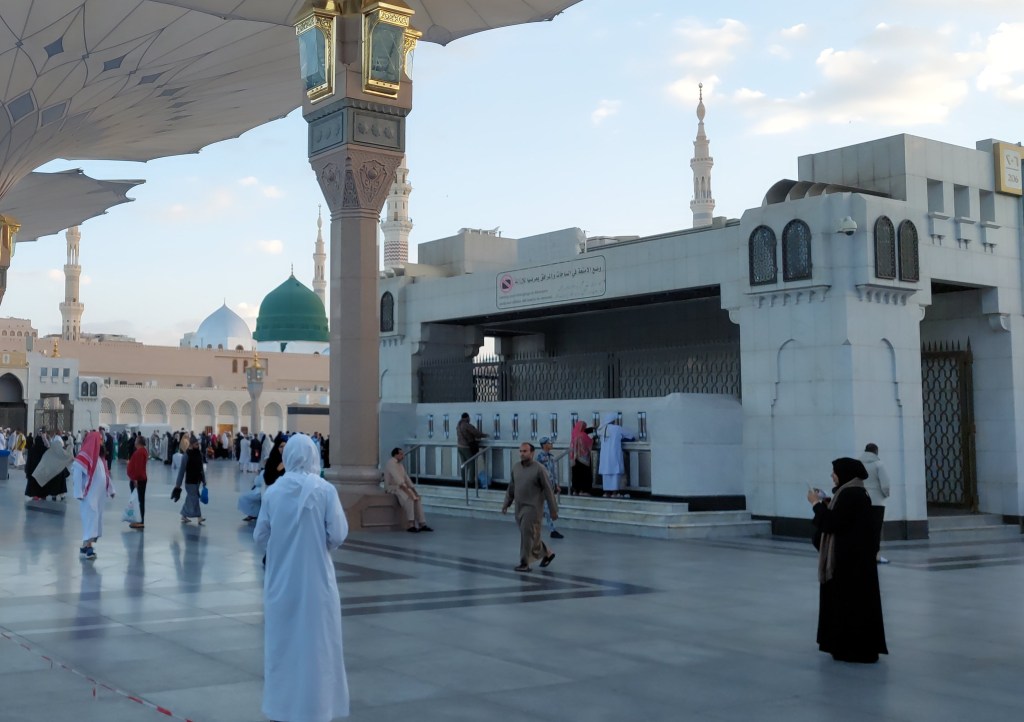
The Green Dome sits lower than you think. Smaller than the minarets, smaller than the hotels behind you, and it does not perform. Underneath it is the chamber holding the tomb of the Prophet Muhammad and, beside him, Abu Bakr and Umar. The chamber is sealed. You cannot go in. Nobody goes in.
Its history is a lesson in itself, and a slightly deflating one if you have grown up with the image as fixed. The first structure over the tomb went up in 1279 — six and a half centuries after the burial — and it was plain wood, no colour at all. Fire took it in 1481, and the Mamluk sultan Qaitbay rebuilt it in brick and lead. The dome you actually see was raised under the Ottoman sultan Mahmud II around 1818. It was painted green for the first time in 1837.
So the most recognisable green object in the Muslim world has been green for less than two hundred years. Before that it was white, and blue, and nothing.
Standing there, I found that enormously moving, and it took me a while to work out why. I think it is this: the thing everyone recognises is the newest layer. The reverence came first and the icon came afterwards, accreted slowly by people who kept needing to mark the spot again, and again, and again. The colour is a fingerprint left by longing. It is not the source of the longing.
That is worth carrying into any encounter with somebody else’s sacred thing. What you are looking at is almost always the outermost coat of paint, applied recently, by people as uncertain as you are.
And the same is true of the building around it. The mosque began in 622 as mud brick and palm trunks, and it was not only a place of prayer — it was a courthouse, a school, and a shelter for people who had nowhere else to sleep. Then came the caliphs, the Umayyads, the Abbasids, the Ottomans, the Saudis, each swallowing the last. In 1909, under Abdul Hamid II, it became the first place on the Arabian Peninsula to be lit by electric bulbs, which means that for a while this was quite literally the brightest spot in the peninsula at night. The original structure is now a small dark seed somewhere inside a complex that can hold well over a million people.
Every one of those expansions was a border crossing of its own: a new technology, a new empire, a new idea about what the building was for, arriving and being absorbed. The place has been metabolising outsiders for fourteen hundred years. I was not doing anything it had not seen.
A machine for saying stay
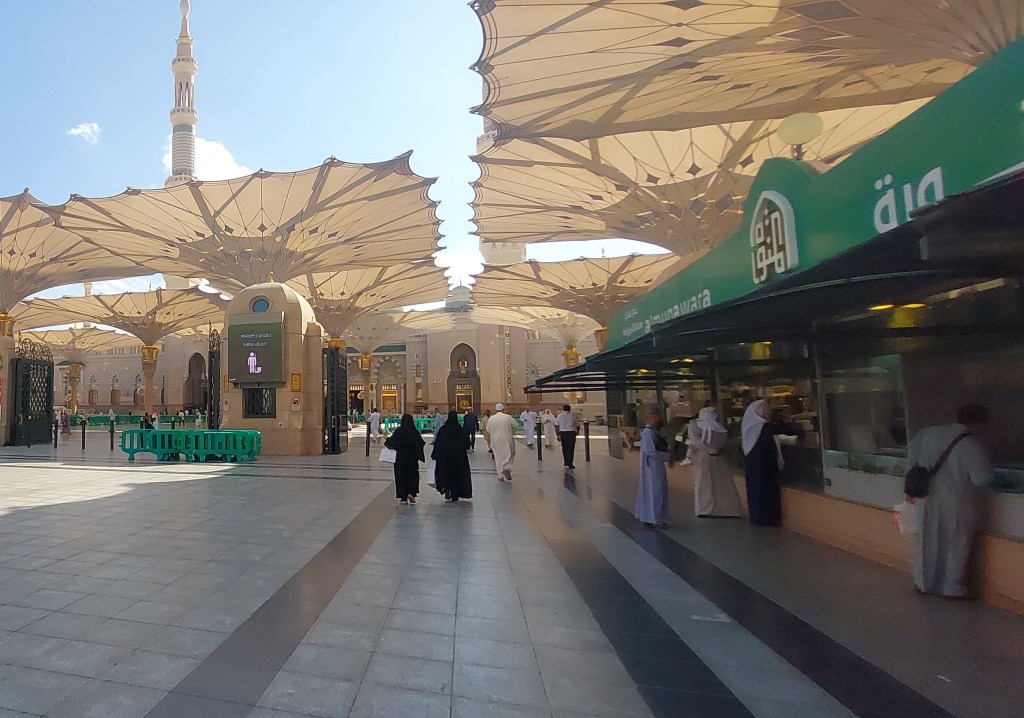
You cannot photograph the umbrellas honestly. I tried, and every frame flattened them.
They are the strangest and best pieces of architecture I have ever stood underneath. Two hundred and fifty convertible sunshades cover 143,000 square metres of open plaza — an area larger than the mosque’s own footprint. Each opens to a square roughly 25 metres on a side, and on a signal the whole array unfolds at once: rigid arms lift, the sand-coloured membrane spreads into a fan vault, and an open square becomes an interior. Three minutes, start to finish.
They were designed by a German firm, SL Rasch, with the fabric specialists at Sefar. The membrane is PTFE, and it is deliberately not white — pure white would have transmitted so much light that the people underneath would have been blinded from above. So the fabric is the colour of the ground it stands on. Mist fans in the columns push cooled air out at the base, and the courtyard runs many degrees below the street.
I learned all of that afterwards, in a hotel room, the way you do. At the time I knew none of it, and it did not matter, because what I felt was exactly what the engineering exists to produce: permission. Under those canopies you can stop. You are not being punished for standing still.
Here is the part that stayed with me. In this climate, shade is not a comfort — it is hospitality, and hospitality is not a nicety here either. It sits close to the root of the whole tradition. Somebody looked at the problem of strangers standing in the sun and answered it with two hundred and fifty folding machines and a great deal of money.
I have been made welcome in many places. I am not sure I have ever been made welcome at that scale, by people who would never meet me and had no idea I was coming.
What the empty stone knows
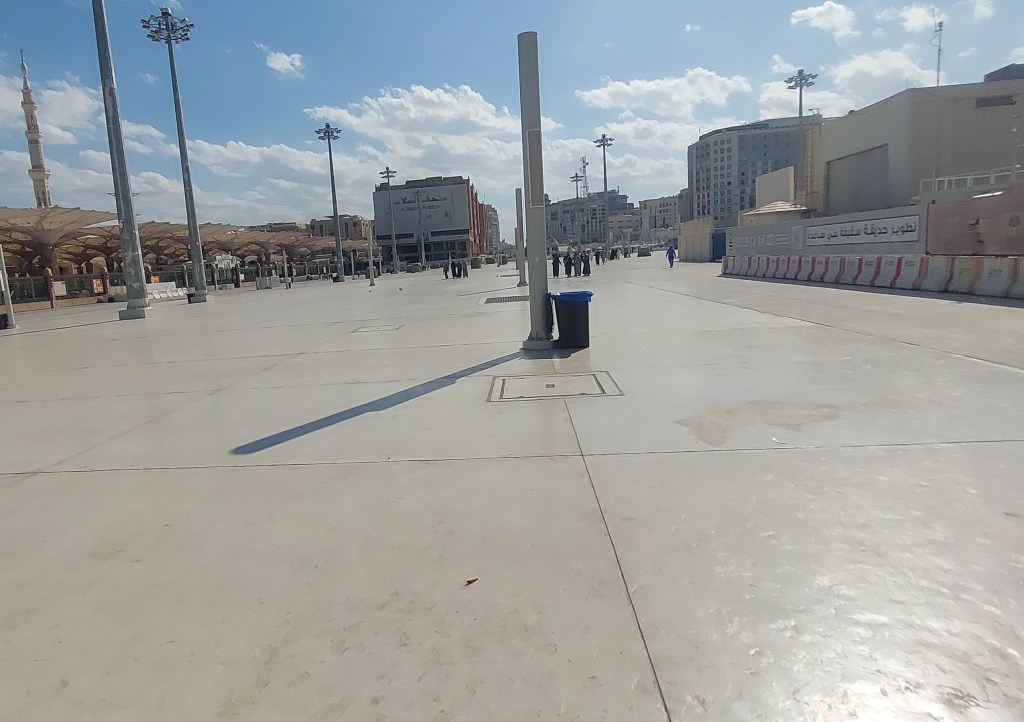
A short walk out from the crowd, the outer plaza was almost completely empty. One bin. One lamp post. One shadow, laid across the stone like a line ruled by somebody with a very long straightedge. A few figures at the far edge, reduced to punctuation. A single dead leaf.
This is the photograph I keep going back to, and it is objectively the least interesting one I took.
Sacred places are photographed at their fullest — the sea of white, the drone shot at night. Nobody photographs the trough. But the trough is most of it. Most of the hours in the life of that building, and most of the square metres on any given afternoon, are exactly this: bright, hot, blank, waiting. Five times a day the whole space fills completely and empties completely, not gradually but the way a lung works, and the emptiness between is not an absence. It is the thing at rest, and it is ready, the way a made bed is ready.
I stood there long enough to feel slightly foolish and then long enough to stop feeling foolish. That progression is, I think, the entire technology of standing still in an unfamiliar place.
Crossing.
I did not have a revelation in Medina. I want to say that plainly, because writing about holy places has a bad habit of manufacturing one, and the manufacture is always audible.
What I had instead was the slow dismantling of a border I had brought with me. I had arrived assuming the edge would be sharp — that there would be a line, and an inside, and that I would be conspicuously on the wrong side of it. What I found was a gradient. Several thousand people in one direction. A hundred metres of nothing in the other, and then the ordinary city: hotels, a museum, hoardings advertising the next phase of construction. The sacred did not stop at a wall. It thinned.
And some borders, I learned, are not there to be crossed at all. The chamber under the dome is sealed and nobody enters it — not the devout, not the scholars, not anyone. That is not exclusion. It is preservation. There is something clarifying about encountering a boundary that is closed to everybody, in a world where most boundaries are closed only to some.
I stood at the edge of it, which is where I belong, and it did not ask me for anything.
That turns out to be a rare and generous quality in a sacred place — and, on reflection, the most persuasive argument for its holiness that I encountered all day.

